When Student Research Becomes Market Infrastructure

His recent work examines the broader socioeconomic consequences of artificial intelligence, including labor markets, public finance, demographic change, institutional adaptation, and the distributional effects of technological progress.
He holds a PhD in Mathematical Finance from Boston University, and previously earned an MSc in Finance and Economics from the London School of Economics. He completed his undergraduate studies in Economics at Seoul National University under the Korea Foundation for Advanced Studies scholarship program.
Modified
Input
Prediction markets as laboratories for uncertainty, sentiment, and regime change
Student research converted into models, data systems, and institutional capability
SIAI Labs as the bridge from academic work to a research-driven service

A discussion that began over beer in London in 2012 has remained in my mind for more than a decade. Professor Hoyong Choi of KAIST, who was then completing his PhD in Finance at the London School of Economics, was developing the reasoning that would later contribute to his work on bond variance risk premiums. The technical question concerned whether observed volatility-market data could reveal the shape of the market’s underlying risk-neutral distribution without forcing the analysis into a convenient but potentially inaccurate parametric model. The broader question was more fundamental: when market prices already contain the actions and expectations of thousands of participants, how much of the underlying uncertainty can be recovered directly from the data?
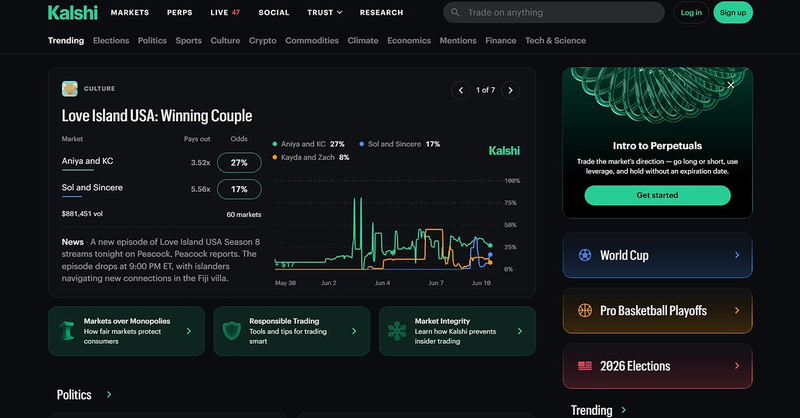
That question now appears increasingly relevant outside conventional financial markets. Prediction-market platforms such as Kalshi and Polymarket allow participants to trade contracts linked to elections, disease outbreaks, climate records, technological breakthroughs, and other uncertain events. Their prices are often presented as probabilities, although they are more precisely market outcomes generated by heterogeneous beliefs, incentives, liquidity conditions, and contract design. The scientific interest is not limited to whether the market predicts the eventual outcome correctly. The complete sequence of prices, orders, comments, and reactions creates a record of how people interpret uncertainty as new information arrives.
This is why prediction markets have become relevant to SIAI Labs. The immediate objective would not be to reproduce a commercial betting platform or attract gambling demand. A non-monetary system based on virtual capital, forecasting scores, and research participation would be more consistent with SIAI’s purpose. Its value would lie in generating real behavioural data, testing forecasting mechanisms, and examining whether methods developed through SIAI research and student dissertations can identify meaningful changes in collective expectations. More importantly, it would demonstrate how academic work can move beyond publication and become part of an institution’s operating model.
From Volatility Markets to Prediction Markets
Modern financial economics has spent decades attempting to describe the distribution of uncertain future prices. Under the simplest assumptions, the expected return and variance of an asset provide much of the information required to describe its behaviour. Those assumptions become less credible when returns are skewed, heavy-tailed, discontinuous, or affected by periods of extreme volatility. Financial markets do not remain within one stable statistical environment. They pass through calm periods, crises, speculative booms, liquidity shortages, and sudden changes in how investors process risk.
The challenge is not simply to predict the next price. It is to identify the distribution from which possible prices are being generated and to recognise when that distribution has changed. Models such as ARCH and GARCH attempt to capture time-varying volatility, while option prices and volatility indices provide market-based information about expected uncertainty. Yet every model imposes assumptions, and those assumptions become most vulnerable precisely when markets enter unusual regimes. A model estimated during a stable period may perform poorly once behaviour, liquidity, or the interpretation of information changes.
Prediction markets face a similar problem in a more visible form. A contract may trade quietly for weeks and then experience a sudden burst of attention after a newspaper article, political statement, scientific announcement, or online rumour. The market price can move not because the underlying event has become objectively more likely, but because the informational and behavioural regime has changed. The analytical problem is therefore not entirely different from volatility modelling. In both cases, the researcher must distinguish ordinary fluctuation from a transition into a new state.
What I Learned from Professor Choi’s Approach
The attraction of Professor Choi’s approach was its empirical discipline. Rather than beginning with a fully specified distribution and asking the data to conform to it, the analysis extracted information from observable market prices through moment conditions. Means, variances, skewness, kurtosis, and higher-order moments each describe different characteristics of a distribution. Under appropriate mathematical conditions, a sufficiently rich collection of moments can provide a close representation of the distribution itself, although real data will never allow researchers to observe or estimate an infinite sequence perfectly.
This type of reasoning is closely connected to the Generalized Method of Moments. GMM does not require every aspect of a probability distribution to be specified in advance. It instead uses theoretically or empirically justified relationships that should hold in the data, and then estimates parameters by determining how closely the observed sample satisfies those relationships. A weighting matrix governs the relative importance assigned to different moment conditions. The method is powerful precisely because it provides a bridge between economic theory and incomplete, noisy market evidence.
What impressed me was not simply the technical method, which could be learned from an advanced econometrics textbook. It was the intuition required to see that volatility-market data could be reorganised into a representation of the underlying distribution. Many researchers possess the same mathematical tools without identifying the same question. The difference lies in recognising which information is latent in the data and how it can be recovered. That distinction between knowing a model and seeing an application has shaped much of SIAI’s educational philosophy.
A Student Thesis and the Detection of Regime Change
Years later, an SIAI student, Yeonsook, developed a related intuition in a very different application. Her master’s thesis, Sleep State Detection Method by Data-Generated Likelihood, investigated whether changes between sleep states could be detected through distributions constructed from observed wearable-device data. Rather than relying on computationally intensive deep-learning architecture, she used a likelihood-based statistical method to test whether the data-generating process had shifted from one state to another.
The underlying idea was elegant. If observations in one period are generated by distribution A and later observations are more consistent with distribution B, a likelihood-ratio framework can provide evidence that the system has changed states. The method does not need to imitate every biological process involved in sleep. It requires a sufficiently useful approximation of each state’s distribution and a disciplined procedure for comparing how well competing states explain the incoming data. Once those components are available, the computational cost can remain extremely low.
The application was sleep-state detection, but the statistical intuition is considerably broader. A prediction market also generates a continuous stream of observations: prices, volume, spreads, order imbalance, forecast revisions, participant concentration, and responses to external information. If the joint distribution of these variables changes, the market may have entered a different behavioural regime. A method originally developed through a student dissertation for wearable data may therefore become relevant to the detection of expectation shifts, information shocks, or speculative episodes in a forecasting market.
Why Prediction Markets Fit SIAI Labs
A conventional university might treat a dissertation as the final requirement of a degree. The student submits the work, receives a grade, and the document remains in an institutional repository. That process fulfils an academic function, but it captures only a small portion of the potential value contained in serious student research. When a dissertation develops a reusable method, a new measurement approach, or an efficient analytical procedure, the work can become part of the institution’s cumulative technical capability.
SIAI Labs can provide the missing layer between academic research and operational use. In the prediction-market case, student work on likelihood estimation, state detection, text analysis, model calibration, or behavioural classification could be incorporated into a shared research infrastructure. The platform would generate new data, the data would expose new research questions, and subsequent students could test improved models on a live but controlled environment. Education, research, and product development would no longer operate as separate activities.
This does not mean turning every dissertation into a commercial product. Most academic work will remain exploratory, and many methods will fail when exposed to real data. That failure is itself informative. The institutional advantage comes from preserving promising ideas, testing them systematically, and allowing one cohort’s research to become the starting point for the next cohort. Over time, the institution accumulates not only publications, but also code, datasets, model comparisons, validation procedures, and practical knowledge about where particular methods succeed or break down.
From Classroom Output to Business Model
The phrase “student work becomes part of the business model” can easily be misunderstood. It should not mean extracting unpaid labour from students or repackaging assignments as commercial assets without attribution. The proper model is one in which students conduct academically supervised research, retain clear recognition for their contributions, and have the opportunity to see their methods tested beyond the artificial boundaries of a classroom exercise.
For the institution, the value lies in building around the intellectual output. SIAI can provide the research question, data environment, technical supervision, infrastructure, and continuity that individual students cannot create alone. A student may develop one regime-detection model, another may study forecast calibration, and a third may examine how news sentiment affects prices. SIAI Labs can integrate these separate contributions into a coherent platform whose cumulative value is greater than any individual dissertation.
The resulting business model is therefore not based on selling the student’s paper. It is based on creating an institutional process in which education repeatedly produces methods that can be validated, improved, and applied. The programme develops researchers; the researchers create analytical components; SIAI Labs combines those components into research infrastructure; and the infrastructure produces new datasets and questions that strengthen future teaching and research. This circular structure is far more defensible than treating education, publication, and commercial activity as unrelated departments.
What a Non-Monetary Market Could Measure
A non-monetary prediction market would allow SIAI to study more than headline forecasting accuracy. Participants could receive equal virtual endowments and trade contracts linked to political, scientific, technological, or economic events. Their performance could be evaluated through calibration scores, forecasting consistency, information contribution, and the timing of belief revisions. Because financial gains would not be the objective, the platform could be designed around experimental validity rather than maximum turnover.
The most valuable output may be the behavioural record surrounding each price movement. When a major newspaper publishes an article, does the market react immediately or only after community discussion begins? Do participants revise their beliefs after reading expert commentary, or do they follow the direction of the existing price? Does a sudden increase in volume indicate genuine information arrival, emotional contagion, or strategic imitation? These questions cannot be answered from the closing price alone.
The platform could also help quantify risks that have traditionally been described only in qualitative terms. Political risk, regulatory uncertainty, technological disruption, and social instability are frequently discussed through narratives because reliable prices do not exist. A carefully designed forecasting market would not produce a definitive price for political risk, but it could generate an observable sequence of collective valuations. With sufficient history, researchers could begin identifying how particular announcements, conflicts, elections, or policy changes alter the distribution of expectations.
Text, Prices, and the Transmission of Information
The development of large language models makes this research programme substantially more powerful than it would have been a decade ago. Prediction markets produce numerical data, but much of the information that moves those numbers begins as text: newspaper articles, policy statements, research papers, social-media posts, analyst commentary, and participant discussions. Until recently, integrating these textual sources into a real-time analytical system required extensive manual classification or narrowly designed natural-language models.
LLMs can now summarise, classify, and compare large volumes of incoming text almost immediately. A research platform could record when a relevant article appeared, extract its central claims, identify whether its tone was optimistic or pessimistic, and measure how market prices changed after publication. It could distinguish an authoritative scientific update from speculative community discussion, while also testing whether traders themselves make that distinction. The objective would not be to assume that the LLM has correctly understood every message, but to create a measurable connection between the information environment and market behaviour.
This creates the possibility of studying price formation at a much finer level. Researchers could examine whether markets react differently to expert reports and sensational headlines, whether corrections reverse earlier price movements, and whether participants become more or less sensitive to particular sources over time. The combination of transaction data, textual data, and participant history would transform a simple forecasting service into an experimental environment for studying how information becomes belief and how belief becomes price.
A Different Interpretation of Applied Education
Applied education is often understood as training students to use established tools in business settings. That interpretation is too narrow. The more valuable form of application occurs when students use scientific reasoning to create tools that did not previously exist, and when the institution provides the structure required to test those tools against real behaviour.
The proposed prediction-market project illustrates this model. The intellectual lineage begins with established work in financial economics on extracting distributions from market data. It continues through student research on data-generated likelihoods and state transitions. It then expands into a platform capable of producing new behavioural and forecasting data. Each layer is connected, but none is a simple repetition of the previous one.
This is the direction in which I would like SIAI’s educational system to develop. Students should not be trained merely to reproduce existing AI models or complete isolated case studies. Their work should contribute, where possible, to an accumulating institutional body of methods and evidence. When that process succeeds, a student thesis does not end at graduation. It becomes one component of a research programme, and sometimes the beginning of a business model.
From Research Exercise to SIAI Labs
A prediction market operated without real-money wagering would remain experimental in its early stages. Its first purpose would be to collect data and determine which questions are scientifically tractable. The platform would need carefully defined contracts, transparent resolution criteria, safeguards against manipulation, and methods for distinguishing informed forecasting from random participation. Most importantly, it would require a clear separation between market prices and claims of objective truth.
Even with these limitations, the project is attractive because it brings together several capabilities that SIAI has already developed: statistical modelling, distributional reasoning, regime detection, AI-assisted text analysis, and the study of human decision-making under uncertainty. None of these components alone justifies launching a platform. Together, however, they form a coherent research agenda that can be tested incrementally.
The most important question is therefore not whether SIAI can reproduce Kalshi or Polymarket. It is whether SIAI can build a different kind of forecasting environment—one designed not around gambling volume, but around scientific observation. Should that environment eventually produce valuable data, analytical tools, or institutional services, the commercial opportunities will follow from the research. That sequence matters. The business model should emerge from the scientific capability, just as the scientific capability has emerged from the work of our students.
His recent work examines the broader socioeconomic consequences of artificial intelligence, including labor markets, public finance, demographic change, institutional adaptation, and the distributional effects of technological progress.
He holds a PhD in Mathematical Finance from Boston University, and previously earned an MSc in Finance and Economics from the London School of Economics. He completed his undergraduate studies in Economics at Seoul National University under the Korea Foundation for Advanced Studies scholarship program.
Similar Post